
It seemed, finally, to be over. The suicides of Hitler and Eva Braun in April 1945 marked the end of Nazi rule. Prisoners of war held in camps across Germany — among them Jozef Pluskowski, who had been detained in the so-called “Officers Transit Camp” at Gerolstein — were at last able to return home.
Warsaw lay in ruins. Jozef’s family had been forced by retreating German units to walk to Grodzisk, where he eventually rejoined them. From there, they moved to Mińsk Mazowiecki, some 40 kilometres from the capital.
Rumours had already spread of the graves in the Katyn Forest, where, in 1940, the Soviet secret police had executed thousands of Polish officers, officials and members of the country’s intelligentsia. Others from Poland’s eastern regions had been deported to forced labour camps in Siberia. Many never returned.
Liberation by the Soviet army brought a very different set of problems. Poland was now falling under Soviet-backed communist rule, and the political freedoms of the pre-war years were rapidly disappearing.
In Mińsk Mazowiecki, Jozef, together with family and friends, attempted to establish an independent mineral and soda-water business. Before long, however, he was summoned by the local authorities, interrogated, and informed that there was no place in the new Poland for members of the pre-war Polish Socialist Party, the PPS.
It became clear that he was in danger of imprisonment, and friends began organising his escape.
This was no easy matter. The Iron Curtain was descending across Europe and Poland’s borders were tightly controlled. But remnants of the wartime underground still existed, and through their help Jozef was smuggled out of Poland by a circuitous route, including small mountain paths, eventually reaching Prague and then France.
In Paris, he became editor of Światło, a publication providing a forum for political ideas and commentary. He worked alongside his fellow socialist Zygmunt Zaremba, and they maintained contact with Tomasz Arciszewski, the former Polish Prime Minister in exile, who was then living in London.
They were also able to publish a selection of Jozef’s poems, Poesie, in 1947, followed by a second edition in 1949 — a literary record of those extraordinary years.
For the family Jozef had left behind, however, the situation was far more difficult.
His wife, Irena — herself a fellow conspirator during the German occupation — remained in Poland with their son, born in 1944. With the borders under increasingly tight control, there seemed little prospect of their being able to join him.
Help came from an unexpected direction.
At the time, one of the few groups permitted — and in some circumstances encouraged — to leave Poland were Polish Jews travelling towards Palestine and, after May 1948, the newly established State of Israel. In the aftermath of the Holocaust and the horrors of the death camps, a large movement of Jewish survivors was making its way out of Eastern Europe.
The Bricha movement — bricha being Hebrew for “flight” or “escape” — organised the clandestine movement of Jewish refugees from Eastern Europe towards British Mandate Palestine and, subsequently, Israel.
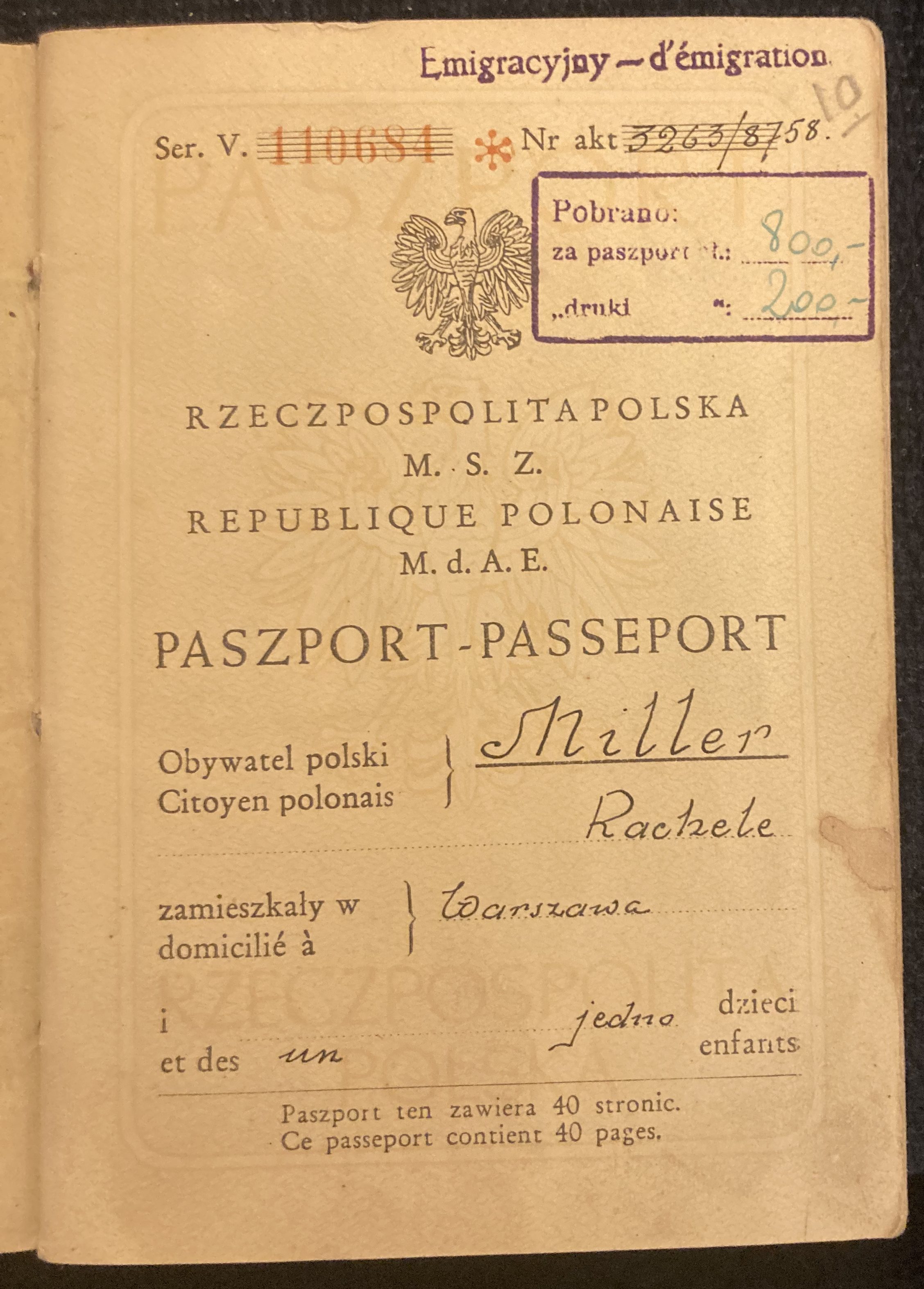
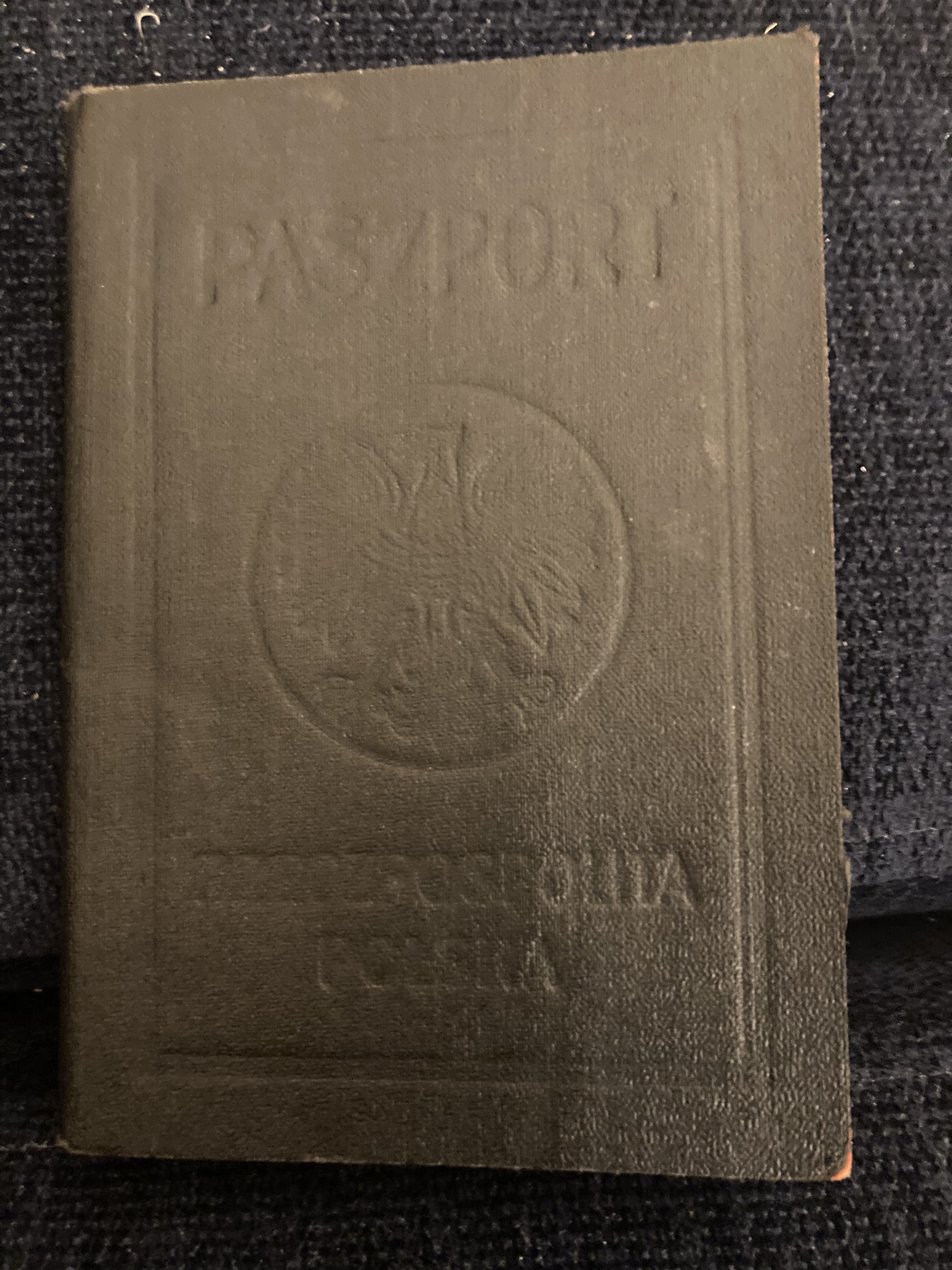
Among the documents used to enable these journeys were black emigration passports, inscribed in Polish and French.
One such passport was given to Jozef’s wife, Irena.
But it gave her an entirely new identity.
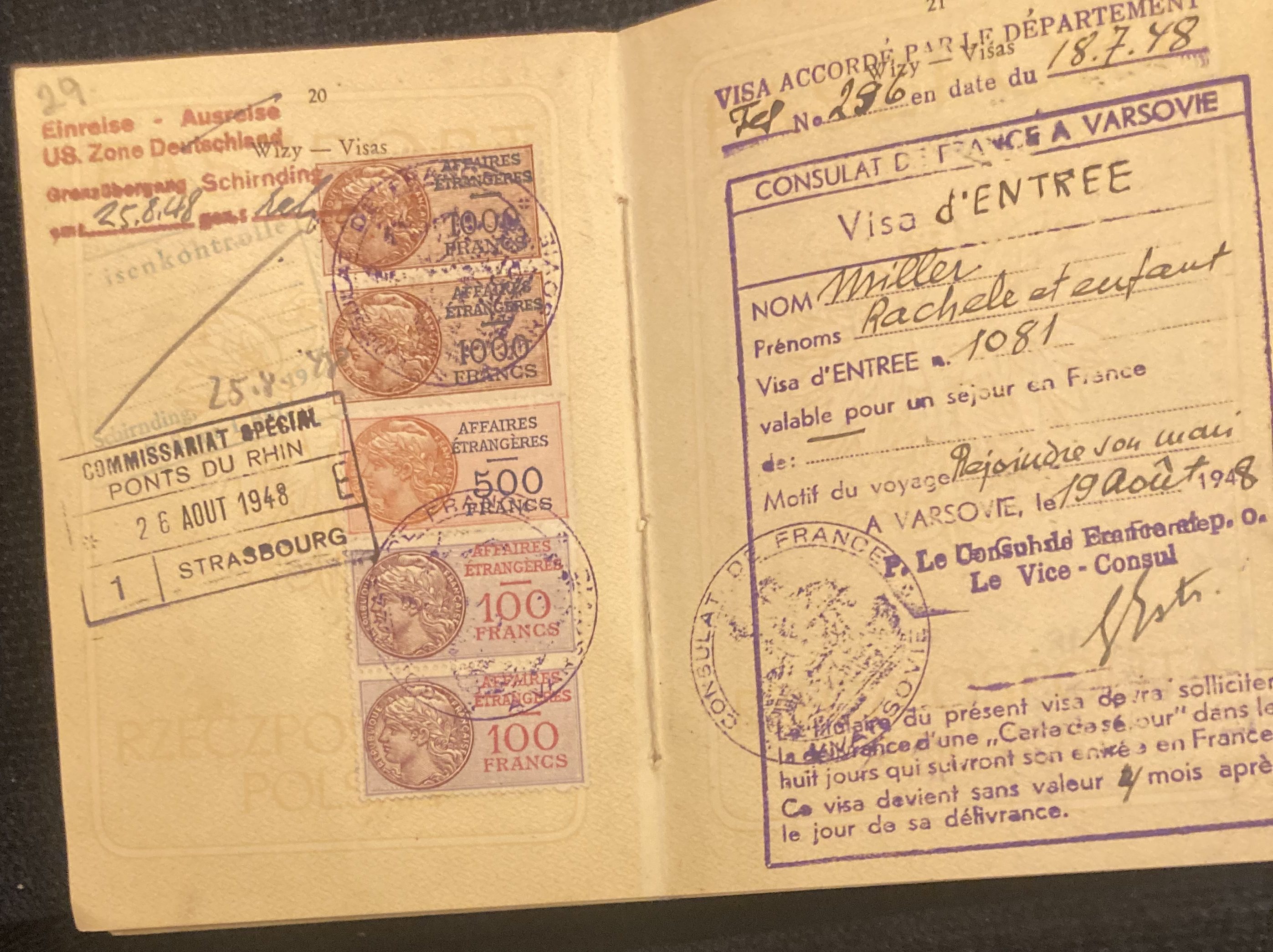
Stamped EMIGRACYJNY / D’ÉMIGRATION No. 3263, the passport was to be used in August 1948 for a journey through Czechoslovakia to France.
Officially, Irena was no longer Irena Pluskowska.
She was Rachelle Miller, resident in Warsaw: a married schoolteacher, 1.63 metres tall, travelling with one child — a son named Adam.
The son, of course, was actually Jozef and Irena’s four-year-old boy.
There was an obvious danger in expecting a child of that age to remember a new name and invented personal details. So he was taught a simple answer to give whenever anyone asked him a difficult question — particularly:
“What is your name?”
His reply was to be:
“Nie pamiętam.”
I don’t remember.
It was a phrase he continued to use, apparently with some enthusiasm, for months afterwards.
Preparations for the journey included carrying packs of cigarettes to use for exchanges, favours and gratuities during the roughly 60-hour train journey. Cash was of limited value along the route; cigarettes were often much more useful. Marlboros, in particular, were highly prized.
Eventually, Irena and her son reached Strasbourg.
There, Jozef was finally able to meet them and take them on to Paris, where he had established a home at No. 3 Rue Brey, close to the Arc de Triomphe. His office was in Montmartre.
In his final collection of poems, Jozef placed himself among those displaced by war, imprisonment and political upheaval:
“… citizens of the world
No citizenship do we have
After prison, detention, confinement and gulag
We travel the roads of the world.”
The 1948 Emigracyjny passport remains unforgettable: a small document that records an extraordinary journey across some of the most tightly controlled borders of post-war Europe, at the moment when the continent was being divided once again.
And behind its false names, stamps and invented identities lies a very simple family story: a wife and a four-year-old boy trying to cross Europe to be reunited with a husband and father.
When anyone asked too many questions, the boy had only to remember two words:
Nie pamiętam.
 If our culture is the shared memory of all historical experiences or, as renowned journalist Ryszard Kapuścinski claims, “we are human because we recount stories and myths”, then the huge painting (twice the size of Rembrandt’s Night Watch) covering a whole wall of the National Museum in Warsaw provides a major opening into the history of Central Europe.
 “Lady with an Ermine”, which was betrayed to the Gestapo within days of the Occupation. Seized by governor Hans Frank, it was hung in his family living quarters and is still remembered as a picturesque backdrop by his son Niklas. Even the largest Gothic altarpiece by Veit Stoss was dismantled and transported to Bavaria on Frank’s orders. Looted and confiscated art was to form the core of the proposed Führermuseum in Linz or the Herman Göring collection. Today, it is estimated that at least 100,000 items have still not been returned to their rightful owners.
 In Soviet Russia, cinema great Sergei Eisenstein directed his 1938 classic “Alexander Nevsky” (complete with a music score by Prokofiev). It portrayed an attack over frozen Lake Peipus against the Russians, by the Livonian branch of the Knights. The film ending, with the heavily armoured Teutonic horsemen drowning as the ice collapsed under their weight, was presented as symbolic retribution for spreading Christianity by the sword.

