Lock Them Up ! Clausi Cum Clave !

Image

How does an ancient institution develop a foolproof system of choosing a leader ? Firstly, it is never foolproof. Secondly, it always evolves.

When the cardinals begin their deliberations, locked in the Sistine Chapel in Rome, on March 12th, their closed meetings follow a tradition established in 1268, in Viterbo.

It had taken 3 years to elect a Pope. The wheeling and dealing amongst the participants was so convoluted, that desperate city magistrates locked the cardinals in the papal palace (clausi cum clave – locked with a key) and eventually resorted to giving them only bread and water for sustenance. When this still proved ineffectual, they apparently pulled the roof tiles off from over their heads to expose them to “heavenly” inspiration. They finally reached a decision and the Visconti Pope Gregory X who emerged, used this precedent to establish rules for what became known as the “Conclave”.

It is only in recent years that the cardinals were no longer bricked up in the Sistine Chapel and were instead finally allowed to sleep comfortably in the Domus Sanctae Marthae in the Vatican, a decision of John Paul II.

Today cardinals represent congregations from across the world in person. In the past the difficulties of travel could result in a small number of easily influenced electors. This was the case in the landmark year of 1492. Columbus had sailed west to find a new world, Lorenzo the Magnificent, patron of the Renaissance, had passed away aged only 43, and the Borgia Pope, Alexander VI, bribed his way to the throne of St Peter . Once in power Alexander and his enforcer-son Cesare, were known to invite any wavering cardinals to dinner . The main course would normally be pheasant, a delicacy, but served in a human skull , to remind them of their mortality. They quickly agreed to all papal requests, which almost led to the destruction of the Church. The sale of indulgences, a payment for forgiveness of sins past, present and future, undermined ecclesiastical credibility. A mere 14 years after the Borgia Pope died, Martin Luther was nailing his 95 theses on the All Saints Church door in Wittenberg. In 1529 the Germanic Princes issued their Protestation in Speyer. The Reformation had begun.

Papal conclaves have always aroused interest, curiosity and flights of the imagination. In the year 2000, Dan Brown followed up his best-seller The Da Vinci Code with an equally successful thriller, novel and film, Angels and Demons, set in an imaginary conclave.There potential papal front-runners are kidnapped and ritually murdered at symbolic sites in Rome. The killer makes his hide-out behind the forbidding walls of the Castel SantʼAngelo, linked to the Vatican by a secret, enclosed passageway.

Real life stories can be far stranger than fiction. This was the case in 1978 when the non-curia, would-be reformist Pope John Paul I was elected only to die 33 days later, the shortest Papacy of modern times. Conspiracy theories abound . One that has been outlined by David Yallop is his carefully documented 1984 study called In Godʼs Name. There were competing alternative theories, but no convincing resolution to the mystery of the sudden papal death.

On October 16 1978, cardinal Karol Wojtyła was elected on the eighth ballot of the second day of the conclave. He adopted the name of John Paul II to emphasize continuity within the Church and followed his predecessor in an inauguration ceremony without a coronation.

I was in Rome to meet a touring group on October 22nd and stood for six hours in St Peterʼs Square, privileged to witness the start of what would become one of the longest Pontificates of all time, 1978-2005. This most widely travelled and popular of all church leaders has already earned the posthumous description of John Paul the Great. His successor Benedict XVI surprised the world this year by offering his almost unprecedented resignation, leading to the current assembly of cardinals .

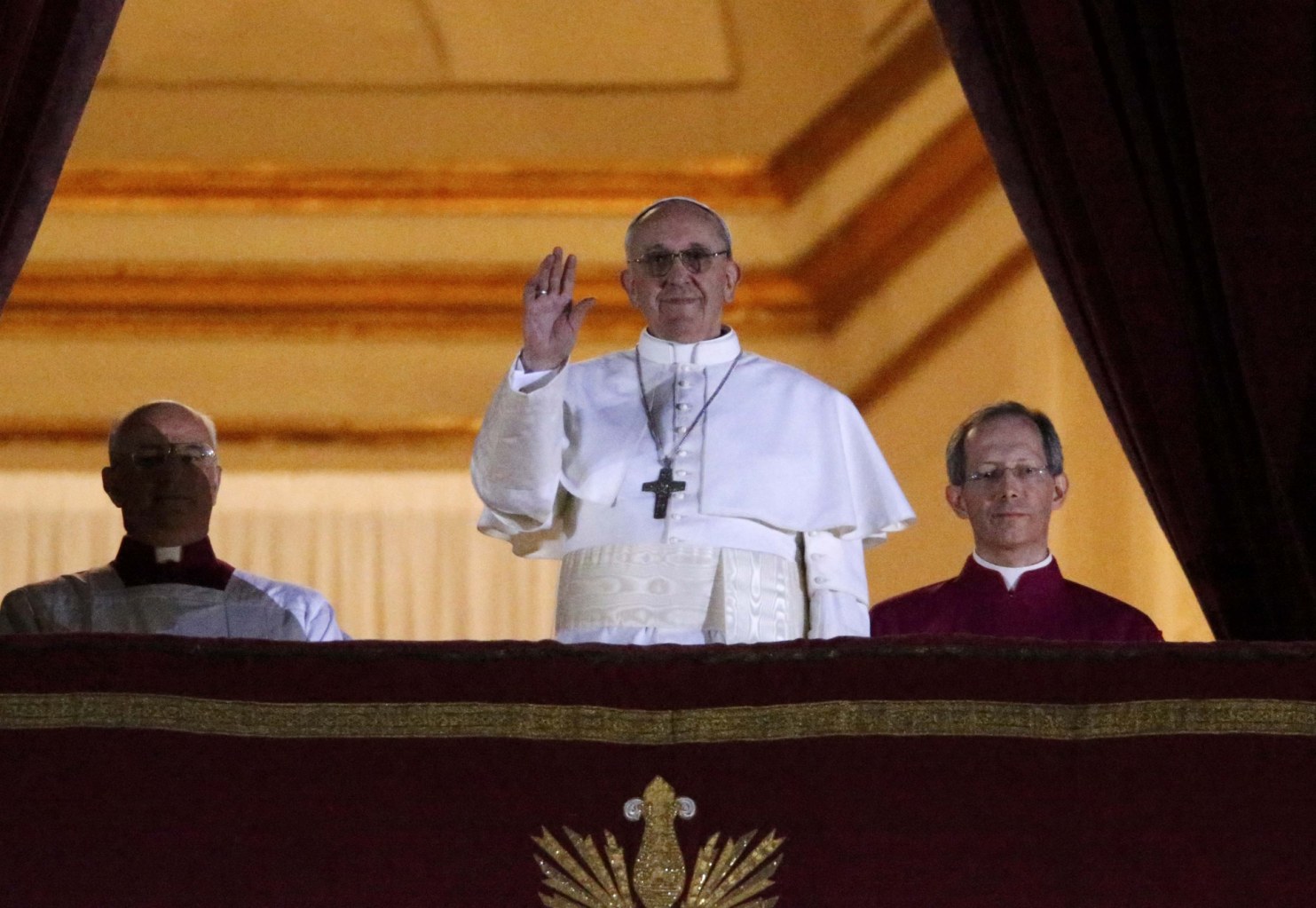
PS: HABEMUS PAPAM! – In what has been the shortest Conclave for 100 years, Cardinal Bergoglio , of Buenos Aires, has been declared Pope. The popeʼs Twitter account has now been changed from “Sede Vacante” to “Pontifex”.
Image

2 Comments

Filed under Uncategorized

The Creator Made Italy, from Designs by Michelangelo

Image

“The Creator Made Italy, from Designs by Michelangelo” MarkTwain

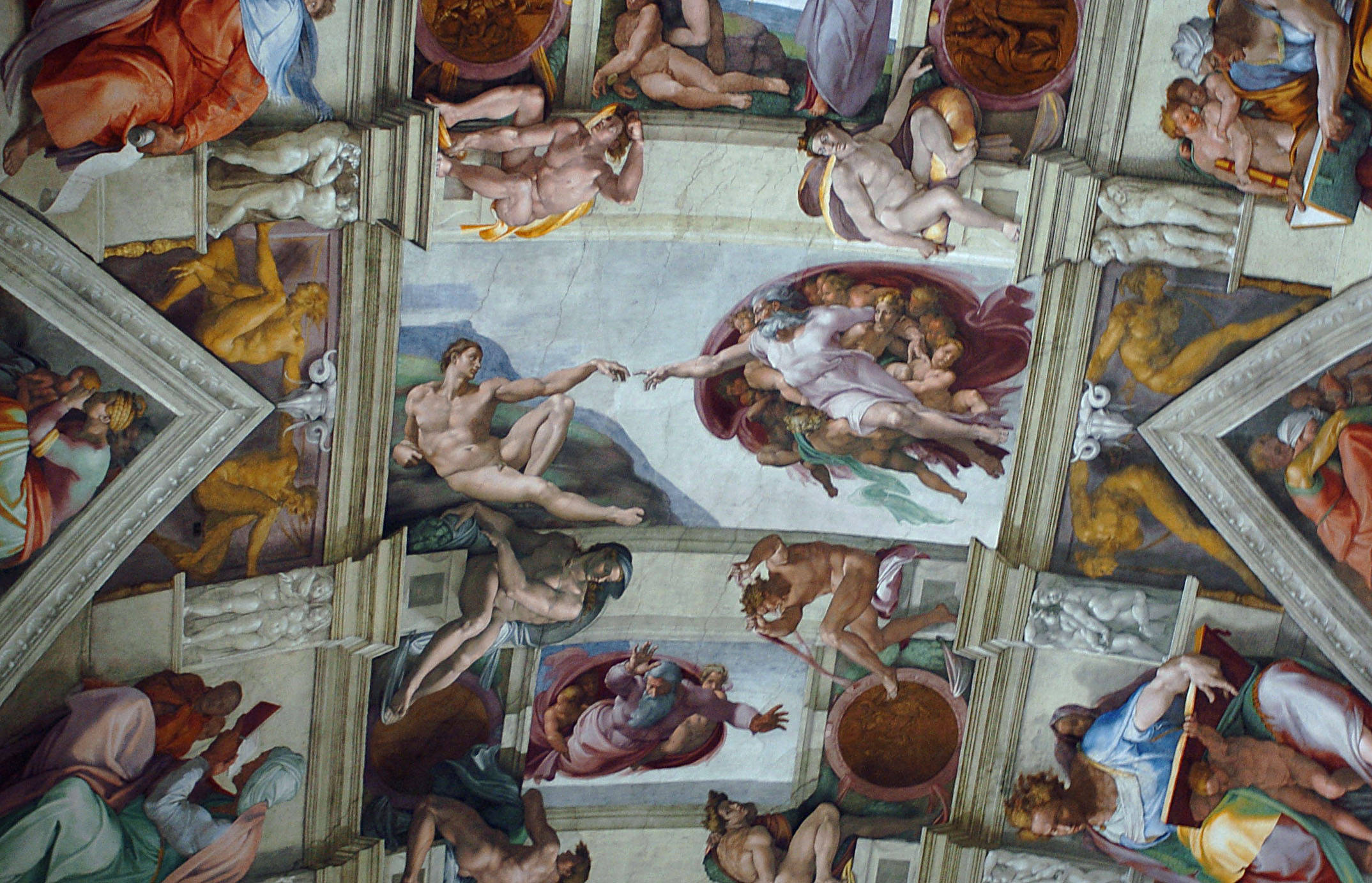
With the Papal conclave starting this week, it’s interesting to note that, while inside the Sistine Chapel, the cardinals are surrounded on all sides by masterpieces meant to provoke them. As George Braque once said: “Art is meant to disturb”!

In his book “When in Rome “, Robert J. Hutchinson noted that “the papal apartments in Castel SantʼAngelo are decorated in frescoes that would have made Hugh Hefner proud…” while the Sistine Chapel “ is covered with naked men and women, all piled on top of one another in what looks for all the world like some sort of biblical orgy “.

Scandalous! Well, that is how some cardinals saw the progress of work in the Sistine Chapel when Michelangeloʼs Last Judgement wall began taking shape.

Image

In fact Biagio di Cesena, papal Master of Ceremonies, visiting the Sistine with Pope Paul III gasped at the naked figures in church and threatened that, if the Pope did not act, he would take it up with the Curia.

Asked to explain his work, Michelangelo pointed out that Armageddon (the Second Coming or end of the world) would find us before God in the form in which He had created us. The Pope said nothing more but, as they left, Biagio was heard still muttering about the “immorality”.

When they returned a few days later the official had a fit because amongst the figures in hell, he had found his portrait. “Holy Father, order him to take me out of there!” – but the Pope would only say that, had he wished to be taken out of Heaven, it could have been arranged, but that Hell was outside his authority. Biagio is still there.

A much-told old story but this is the dramatic spectacle that will confront the cardinals as they take their oath of secrecy at the start of the 2013 conclave. They will also be aware of the spectacular presentation of Old Testament stories above their heads, the only ceiling that “everyone must see before they die

ImageDuring pauses they may also note a macabre detail on the upper part of the famous wall. It is a self-portrait of a long suffering Michelangelo as a skin hanging from the fingers of St Bartholomew who was flayed alive. Pope Paul III himself is gratefully portrayed as St Peter, holding the keys to the Kingdom of Heaven.

These are but a few of the stories held within the walls of the Sistine Chapel, meant to remind the conclaved cardinals of their duties to the outside world.

The conclave starts with a cry of “Extra Omnes!” (everybody out) to outsiders, and as the cardinals start their pensive gazing at their surroundings for the next few days or weeks, we too applaud and murmur “Go Cardinals! The whole world is watching!”

4 Comments

Filed under Uncategorized

The Golden City on a Hill

Image

I only met Marc Chagall once. It was on Oct 9th, 1978 having just emerged from the inner rooms of the Chagall National Museum ( Cimiez, Nice) in somewhat of a daze from the mesmerizing combinations of his colors, dreamlike compositions and floating figures that inhabit his characteristic pieces.

I saw a short man, with fine wispy hair, a long raincoat and a quizzical smile. The face was familiar to me from photographs, and he was exchanging a few words with the attendants by the entrance. I guessed immediately it was Monsieur Chagall.

A French president described Chagall as the painter of Joy in Life –  those large canvases on the museum walls, inevitably leading to the smaller rooms with the brilliantly colored themes from the Song of Solomon or the Song of Songs, was in itself a joyful journey into the deep Mediterranean sauce of our European culture. Although Chagall himself had cautioned that his painting was not really European, but rather partly oriental.

I was particularly fascinated with the scenes of paradise in the earlier pictures, but it was the lovers floating or flying over Jerusalem that caught my attention as the image of the “shining city on a hill” was that of St Paul de Vence.

I introduced myself to Monsieur Chagall, said “Bonjour”,  “Merci pour votre vision!”, then  asked him about the portrayal of St Paul de Vence. He replied kindly, explaining that, although he had a studio for some years in nearby Vence, it was St Paul that was really special. It was there, in his home known as “La Colline”, that he felt most “en place”.

“We all carry a vision of Jerusalem in our hearts”, he added, “remember Psalm 137” (which contains the famous verse “if I forget thee O Jerusalem, let my right hand lose its cunning”). He took a small illustrated book from the kiosk, signed it, gave it to me with a smile and was gone.

When wandering through the crowded streets of St Paul, you eventually emerge at the far end of the Rue Grande, where you can find a narrow gateway leading to the old village cemetery There on the right is a simple stone slab over the remains of the spiritual dreamer and sublime colourist, where I like to pause and place a pebble.

ImagePS : Currently an exhibit entitled “Chagall between War and Peace” is showing at the Musée du Luxembourg in Paris, until July 21

Leave a comment

Filed under Uncategorized

A Home for the Wanderer

Image

Among the artists associated with Saint Paul de Vence, Marc Chagall is the most fondly remembered. He lived in many places throughout his life after having been forced to leave his native Russia due to “differences” with the post-revolutionary soviet bureaucrats.

He made his home in Paris and later left for New York  during World War II. Once there, comfortable in his house in High Falls, he decided that “America is more dynamic, but also more primitive. France is a picture already painted”. At the same time, his cosmopolitan side made him exclaim “I’m a foreigner here, and at the same time, I’m at home because I’m a Jew”.

Returning to France, he decided to live in Vence itself before moving and settling permanently at his last home, “La Colline”, in St Paul de Vence. One of his neighbors in Vence, the existentialist writer Witold Gombrowicz, claimed that “any artist that respects himself, ought to be in every sense of the term an émigré”. Marc Chagall certainly fulfilled that description.

Leave a comment

Filed under Uncategorized

Heart of the Riviera. St Paul de Vence and the artists

Image

Ever since Lord Brougham was turned away at the France/Italy border-crossing in 1834 (due to an unfortunate case of “foot & mouth disease”) and by lucky chance  discovered the charm of the bay of Cannes with its unique microclimate – the French Riviera, or “the Côte”, has been a legendary destination.

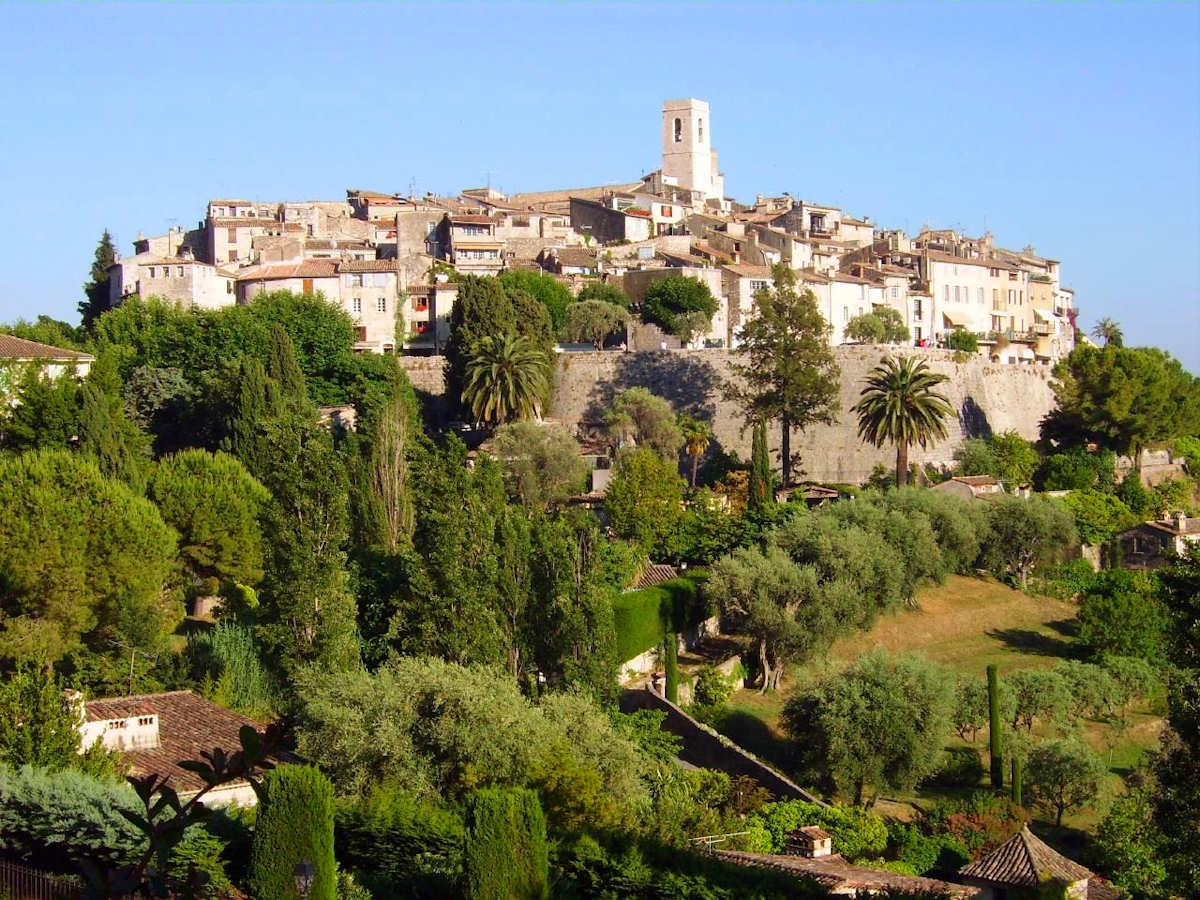
Not only the azure blue color of the sea but, as many artist-residents explained, “it’s the light” which inspired the brilliantly coloured paintings by Matisse (in Nice), Renoir (in Cagnes), Picasso (in Vallauris), and particularly Chagall at St Paul de Vence, the old town which in itself may be the most interesting objective for any traveller, both for its physical presence and its various memories and meanings.

It is worth leaving the cities and dramatic coastline of the Riviera to drive into the valley of St Paul de Vence. This once frontier-town, situated between France and the former state of Savoy, sits comfortably around the upper contours of the hill slope, rising to a high point at the ancient chapel tower and still surrounded by the ramparts of the defensive wall.For many moments of the day, it looks from a distance like a floating mirage, a ghost from the past. In fact, although lovingly preserved and only accessible on foot, the town could not be more alive and is much used both by permanent residents and transient visitors.

Before reaching the approach to the main gateway, the huge letter “M” of welded steel beams by Alexander Calder points away from the town towards the celebrated Maeght Foundation, one of the most valuable contemporary collections of European 20th Century art.

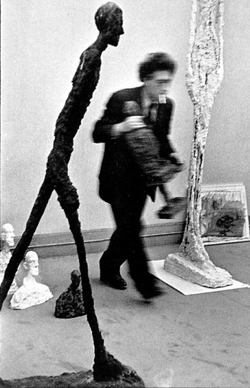
albertoFounded by Aimé Maeght in 1964, it contains, amongst many others, works by Chagall and a whole courtyard of 60 Giacometti bronze sculptures, including two of his famed “Walking Men”.Asked to describe Giacometti, Chagall once explained “he feels profound forces of nature.!”In 2010, a Giacometti “Walking Man” ,“l’homme qui marche”, was sold by Sotheby’s in London for a then record breaking £62M – cheered on by the late Aimé’s granddaughter Yoyo  who later said that her feeling at the time was “Bravo Papi!…. and after that, of course, I was furious because I thought of the insurance!” (Referring to how much she’d have to insure the two remaining ones in the courtyard, never mind the rest of the sculptures there!).

If instead of taking the turn towards Maeght, one continues towards the historic town, the outstanding landmarks on its approach are the Colombe d’Or and the Café de la Place – each an unforgettable destination in itself.

The Colombe d’Or, a comfortable but rustic hotel/restaurant, came into its own when the Côte became the center of bohemian artistic France.Matisse, Chagall and Picasso were regulars at the inn and the Roux family owners built up a now fabled personal collection  by accepting paintings and sculptures, from the then unknown artists, in lieu of payment for hospitality.  The collection is still displayed in the dining room walls.

There, it is rumored, Chagall exchanged words with Picasso. The latter had suggested “when Matisse dies, Chagall will be the only painter left who understands what color really is” – to which Chagall countered saying “what a genius that Picasso, it is a pity he doesn’t paint”.

Amongst the many famous guests were Chaplin, Marlene Dietrich, Edith Piaf, Greta Garbo, Jean Paul Sartres and Simone de Beauvoir, Sophia Loren, Catherine Deneuve, Peter Ustinov, and many more.The actor Yves Montand and later Bill Wyman of the Rolling Stones liked the unique ambience so much that they even had their wedding receptions there.

458_001

Looking at the town from the valley below, is the 17th century farmhouse of Bill Wyman, whilst Roger Moore, after his James Bond appearance at the Cannes Film Festival, purchased a home nearby and was a regular at the Colombe d’Or with his actor friend and restaurateur Michael Caine, until forced to relocate to Monte Carlo when his 3rd marriage broke down.

On many occasions the Café de la Place across the road from the Colombe d’Or saw a cheerful crowd on the terrace cheering Yves Montand on to victory, in the boules/pétanques game played on the Grande Place in front of it – and roaring with laughter when the losers had to kiss a ceramic lady’s bottom, known as “Fanny”, hidden behind red velvet curtains near the bar.

It is this atmosphere that attracts visitors to St Paul from around the world, making it possibly the single most visited town along the whole French Riviera with something to offer to everyone in its antique shows, art galleries, original souvenirs,panoramic views and a living record of the past.

1 Comment

Filed under Uncategorized

Heine, Hitler and the Lorelei;

Image

The Lorelei Rock, located at the sharpest, most dangerous bend in the Rhine River, has for ages captured the imagination of those who have gazed upon it – albeit usually out of fear – blaming the alluring song of the “Rhine Maiden” for disasters which include a series of boats pushed by currents onto the rocks lining the river.

San Francisco’s emblematic counter-culture group, Jefferson Airplane/Starship, were to perform there once in the summer of 1978 at the open amphitheater behind the Lorelei. Then, disaster struck. Lead singer Grace Slick (Somebody to Love, White Rabbit ) refused to appear, maybe too sick, probably too drunk. The concert was cancelled and the gathered audience erupted in fury, throwing bottles, setting fire to the stage, and destroying all instruments and equipment. The curse of the Rhine Maiden had struck again and the group never recovered.

Certainly the huge rock, rising over 180m above the river, is an unmistakable landmark. The Rhine River bends to its narrowest point at the base of the Lorelei and, with a depth of 22m, that narrowness creates an unusually strong current that hides treacherously submerged rocks and sand banks.

Although protected by the “Warschau” warning light signals (operated from the river control headquarters at nearby Oberwesel) and the use of specialist river pilots, numerous incidents still happen. As recently as 2011, a barge carrying 2400 tons of sulphuric acid from Ludwigshafen to Antwerp, capsized blocking the river for days – causing major disruption along what is, in reality, the major aquatic highway of Europe and costing the German economy Millions in damages.

Since the early 19th century, blame for these strings of disasters have been laid on a female river spirit imagined by the writer Brentano and then woven into a dream tale by Germany’s then favorite Romantic poet Heinrich Heine who was fascinated by the Rhine and its ancient Niebelungen myths.

In 1824, Heine wrote the lines to his “Song of the Lorelei” with foreboding:

I wonder what it presages

I am so sad at heart

A legend of bygone ages

Haunts one and will not depart

Heine’s song was captured in his “Buch der Lieder”, which then became one of the most popular books ever published in Germany.  Some years later composer/songwriter Friedrich Silcher added music to Heine’s verse and a popular classic was born – intriguing artists and visitors ever since – not least of which because of the endless cruise ship playlists that feature the song as they pass the rock.

A brief list of the artists inspired by Heine include Franz Liszt (who wrote the song “Die Lorelei” in 1841), a propagandist painting by Oskar Kokoschka in 1941, and more recently a poem by Sylvia Plath (“Lorelei“, 1960) , who reflected on the Rhine Maiden’s actual silence as its most disturbing aspect. For most travelers, however, a bronze statue of the Rhine Maiden combing her long golden hair, created by Natascha Alexandrova (aka Princess Jusupov) placed on a jutting extension to St Goarshausen in 1983, is the most obvious reminder of the legend created by Brentano and Heine.

Heine lived in turbulent times. While studying at Bonn University, he joined the new Nationalist movement. In 1819 the students threw “unpatriotic” books and papers into a huge bonfire. He recoiled in horror, later portraying a character in his tragic play “Almansor” who, reacting to the burning of the Koran and the Inquisition during the Reconquest of Spain , by proclaiming  “where people burn books, in the end they burn people” .  This is now inscribed over the entrance to Yad Vashim Holocaust Museum in Jerusalem, the US Holocaust Museum in D.C. and the Opernplatz, Berlin.

Despite converting to Protestantism (in 1825) as his “ticket” of admission to European culture, Heine still ended up getting thrown out of Germany by the Nationalists he was once a part of and exiled in Paris, albeit as a celebrity.

Analysing extremism on the Right he wrote that  “Thor will leap to life with his giant hammer and smash the Gothic cathedrals” (painting a picture of the legendary hero destroying the iconic images that were held up as the traditional basis of a German identity).

Later then, after meeting Karl Marx (an admirer of Heine’s at the time), he foresaw that  “the future belongs to the Communists. With fear and terror I imagine the time when those dark iconoclasts come to power”.

ImageHis words were prophetic, essentially predicting the rise of both Stalin and Hitler – with the result that, in 1933, as books were burnt once more nationwide in Nazi Germany, Heine’s books were included amongst those of Einstein and Freud.

Adolf Hitler, like Heine was fascinated by the myths of the Rhine (although as interpreted by Richard Wagner) and often came to contemplate the river. He normally stayed at the picturesque Rheinhotel Dreesen at Bad Godesberg, sometimes on matters of state  (meeting Chamberlain which led to the Munich Peace Pact), sometimes to fantasize on his destiny. From this location, downstream from the Lorelei, he decreed that, although the song of the Lorelei could still be published, it had to be attributed to an “unknown  author”.

When Nazi-led armies reached Paris in 1941, German Radio reported  “on Montmartre, the grave of Heinrich Heine, the famous German Jewish poet, has been desecrated and demolished with no trace of the grave left”. Today the grave has been rebuilt, and monuments to Heine stand in both Paris and Berlin, as well as St Goarshausen by the Lorelei.

Hitler’s fascination with the Niebelung myths continued to his last days in the bunker in Berlin. Original manuscripts of Wagner’s Rienzi and Götterdammering stayed with him to his dying day. He ordered the Siegfried Funeral March, the death of the hero, to be played over the loudspeaker system during his last days in the Berlin bunker that served as his headquarters, and after their suicide,  the remains of Hitler and Eva Braun were burnt, like those of his hero Siegfried, on a funeral pyre.

So the granite rock at Km marker 555 is a major feature of any Rhine journey, with its still present dangers and ghosts, and its anchored dreams and ideas.

Dictators and extremists have always understood imagination as a threat to their society. In a period of instant communication but limited content, it is worth reflecting on Russian Nobel Prize writer Joseph Brodsky’s warning:

“There are greater crimes than burning books, one is not to read them ”

3 Comments

Filed under Uncategorized

Sympathy for the Devil::

!8108499268_580a47c21e_zA good story has always had the power to evoke imagination in the mind of the reader – but nowhere more so than in Europe – where we can see evidence of that power everywhere.

For example:  Casa de Pilatos, Seville; Lago di Pilato in the Marche of Italy ; The Pilat regional nature park near Lyon; The Tomb of Pilate (a Roman pyramid) in Vienne and particularly Mount Pilatus in central Switzerland.

It is possible that Mt Pilatus got its name from “Mons Pileatus” or “cloud-covered” according to early traveller John Ruskin. But the more frequently  cited meaning of the name refers to the Roman procurator of Judea, Pontius Pilate,who presided at the trial of Jesus Christ in Jerusalem.

It is said that, following his death (possibly by suicide, although there are those that have other theories),the body of Pilate was thrown into the Tiber, thrown into the Rhône, into Lake Geneva near Lausanne or ultimately carried by bearers who, panicked by thunder and lightning, threw the remains into a glacier pool on the mountain which also bears his name.

Climbing the mountain itself was forbidden until 1400 when bishops led a procession from local communities to perform acts of exorcism and purification. It is still believed, however, that every Good Friday a shadow appears from the waters and washes its hands….

These and other legends provided fascination for countless European artists and writers: Anatole France in  “Le Procurateur de Judee” , Nikos Kazantzakis in ” The Last Temptation of Christ”  or perhaps most memorably ” The Master and Margarita” by Stalin-period Russian great Mikhail Bulgakov.

This last book concerns a version of the trial of Jesus imagined by the Master in which Yeshua (Jesus) states to Pilate that  “In fact I am beginning to fear  that this confusion will go on for a long time . And all because he writes down what I said incorrectly.”

Bulgakov’s tale intrigued Mick Jagger so much in the late 1960’s, that the Devil appeared in the Rolling Stones’ Beggars Banquet disc on the track “Sympathy for the Devil”, where he  “made sure that Pilate washed his hands and sealed his fate”.

Some old stories never die but are recreated in our imagination.

1 Comment

Filed under Uncategorized

The Camargue and the Spirit of Travel!p

ImageTo capture the essence of a place, one needs to explore the local imagination. Such is the mysterious Camargue, with its saline water, pink flamingoes, white horses, and wild bulls.

There are echoes of ancient Rome throughout the region, and at its tip the Saintes Maries de la Mer – where a ship without a mast or rudder arrived from the Holy Land after the crucification, carrying the biblical Marias – including Mary Magdalen (the suggested bride of Christ in “Holy Blood and Holy Grail” as well as the “DaVinci Code”).

Were her remains buried in nearby St Maximine or spirited away to Vezelay (the “sacred hillslope” of Burgundy), crossroads of the great pilgrim routes? Certainly these are some of the ancient stories told throughout the region – Not just of the “Marias'” but of their maid servant Sarah as well – patroness of the gypsies, the ancient nomadic migrants, once from Himalayas, who come annually to her festival in the Camargue in search of healing and health in the sprawling delta of the Rhone. 

It is also here that the Gypsy Kings wrote songs of love and where Bizet’s “Carmen” came to life in an atmosphere of bullfights, gypsy lore and music. 

The unique feeling of Arles – where Van Gogh painted what he felt;  Picasso mused that “It takes a long time to become young”; and Ernst Hemingway, inspired by Cezanne’s blocks of colour in his paintings of Mt St Victoire, arranged his paragraphs into acute formations. 

The fragments of these and other ideas spread throughout the Camargue is representative of the “soul” at the heart of every traveller – for as Italo Calvino (the famed Italian writer) offered in his lectures, “Who are we if not a combination of experiences, information, books we have read, things imagined”. 

1 Comment

Filed under Uncategorized